The government seems to think the latest answer to the problem is to force people to stop using cars.
In my opinion there are 4 ways we can delay the on-set of this gridlock:
- Build more roads.
- Build more lanes on existing roads.
- Increase throughput on existing road-space.
- Invent a new mode of transport (a Tardis or Disposable Private Space Ships).
Building more roads and/or widening existing roads is expensive and will take time. It is important and needs to be part of a strategic plan.
I wish to discuss throughput on existing road space, because this is where government policy has gone wrong.
I understand the government focused on reducing harmful emissions, and improving road safety which is measured by number of casualties.So for reasons of safety, they lowered some speed limits and increased enforcement in all areas (a current government initiative).
For arguments sake, let's change the law so no car can legally travel over 40mph at any time of day? Brilliant. We now have complete gridlock. So gridlock means less car miles, which means less emissions, cos everyone is parked on the M6 with the engine off and the radio on. Gridlock also means pedestrians, rabbits and foxes can stroll across the M6 in complete safety. Everyone's happy at Greenpeace.
These policies ARE significantly decreasing throughput on the roads and increasing congestion. If traffic is permitted to travel at twice the speed down a stretch of road, this will enable far more cars to pass along that stretch. This won't be exactly twice as many because on a full road the extra stopping distance for each car would become a factor.
Additionally, a car's emissions are at their worst when accelerating. When at a steady speed, 40 or 80 emissions are similar. Except if I'm doing 80 I'm covering twice the distance for the same emissions. Speed cameras and speed bumps are being built everywhere. These make people brake and accelerate - more noise pollution and emissions than travelling at a steady speed. (As an aside what are these mini speed bumps called traffic islands for? Most cars can travel straight over them at 60 no problems - one wheel either side and the bottom of the car clears the island. Sports car get damaged travelling over them at 5mph. They clearly do not work, so why are they being installed everywhere?)
There is a really tough decision to be made here. Obviously reducing speed gives drivers longer to react in an emergency. Anyone can see this will reduce the risk to all road users. But is it worth the cost of increased congestion and delayed journeys for all motorists? While I'm not saying road safety isn't a big issue, we have to accept a certain level of casualties are unavoidable. With the current blame culture I can understand those who are responsible for speed limits taking the safe option to avoid being prosecuted over a single death that is deemed to be caused by increasing a speed limit.
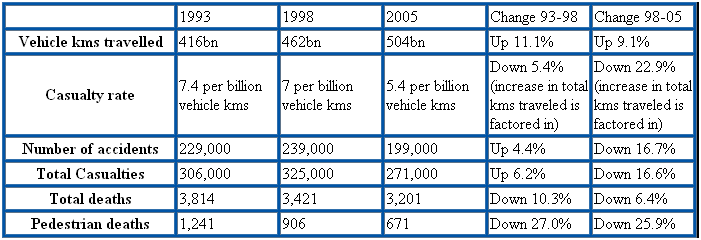
I have dug out the Transport Statistic of Great Britain 2006, page 138, section 8.1 "Road accidents and casualties 1950-2005'. I have chosen to look at 3 points in time. 1993 was when comparable figures started. I am taking 1998 to be about when policy was examined, speed limits were more strictly enforced, reducing road casualties became a priority and all road building was halted. The third time point is the newest possible, 2005. This is heavily biased in favour of the current figures because the first change colum covers the 5 years of 1993-1998. The other change colum covers 7 years of 1998-2005. Click on the table below to zoom in.
For further information, you may wish to see this article of January 1998 when John Prescott promises to tackle the issue of congestion :) . There is also a very good timeline of Labour's transport policy 1997-2002 in The Guardian
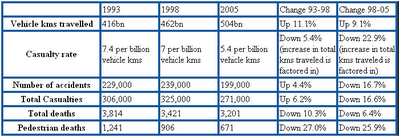
On the positive side, this shows that the trend of the casualty rate, number of accidents and total casualties has significantly changed for the better. Interestingly the growth in total kms travelled has slowed considerably. But, examining the trend in number of fatal casualties - though the figures have reduced in real terms - the rate of this reduction is worse in the last 7 years than it was in the preceding 5 years. It is clear the trend in the reduction of deaths on the road has not improved in the last 7 years.
I have to question whether the actual reductions seen, and the positive trends are due to central government transport policy, or due to advances in car design and safety.
Where I am going with all this is that I support an increase in speed limits. Cars are now faster. They have better brakes with ABS as standard. There are numerous modern driver aids like traction control. They all have countless safety features, airbags, crumplezones etc. But speed limits have not increased to take these advances into account. In actual terms speed limits have decreased due to the advent of speed cameras everywhere making people more careful about rigidly observing speed limits. I recall back in 1990 when I learnt to drive no police patrol unit would bat an eyelid at anyone travelling at 85mph on the motorway. If you were doing 70mph on the motorway you were causing an obstruction. On a dry clear day it is seldom unsafe to travel 90 in the middle lane of a motorway.
To finally relate this back to the issue of road congestion, higher speed limits means more throughput.
You may have noticed I do not include forcing people to stop travelling by car in my list of options at the top of the article? I did seriously consider this, but decided it is not viable because there really is no alternative. Whenever you want to go somewhere, you can walk out the house, get into the car on your drive and travel immediately and directly to your destination with security and comfort.
The final point I will make is about variable road charging. I strongly disagree with this concept, which is already used on all train services. Do we really want to get to a point where our lives are ruled by charging time zones? "I won't go and see Mum now, I will wait until after midnight to travel because it is cheaper/free".
The reason this is proposed for cars is to re-enforce the argument for doing it on the train system. The train service is in demand at specific times of day. What do the train operators do? Put on more trains with more seats to serve the demand? Don't be daft, let's ramp up the ticket price to reduce demand to match the available service. I mean £202 standard peak-time fare from Manchester to London by train is taking the piss. I can fly RyanAir from Blackpool to London for £58.64 return including all taxes. By car its a 400 miles return journey, about 14 gallons of petrol, £5 a gallon, £70 plus parking to travel by car. I don't need to say anything more about that! Stephen Ladyman, Minister of Roads stephen.ladyman@dft.gsi.gov.uk replied that charging more on peak times was necessary to reduce the subsidy of the rail network!!! How can you not make a profit with a monopoly and a starting £200 ticket rate for a 400 mile journey??????
My fourth tongue-in-cheek option may not be completely unrealistic! Maybe the answer to this is to switch the railway off, and give everyone a Tardis! How about stealing the idea of the start sequence for Futurama when everyone travels round town in a private space ship. This is about as realistic a plan for transport in 2015 as a recent report that concludes 'motorist should pay for roads'. Of course, we get them free now - the 75% tax on Petrol and road duty is just to pay for Prescott's mansion.
Readers: Please click Comments under any of my posts and leave me your input/support/criticism.
I need to try harder at keeping these things short! Signing off - Chris
Update: Above train journey is now £219 return thanks to new year ticket price rises. Also the government is slagging off Ryanair.